The most critical steps in BESS site commissioning
In every Battery Energy Storage System (BESS) project, there is a defining moment when everything comes together: commissioning. Commissioning is not just another project milestone. It is the point where design meets reality.
It is the stage where theoretical models are validated against real-world conditions, performance guarantees are proven in practice, and customers experience for the first time exactly what they have invested in.
Quite simply, commissioning is where confidence is either built or lost. A well-executed commissioning process ensures the system operates safely, reliably, and delivers the promised value from day one. It is also the phase where long-term operational performance and commercial readiness are truly verified.
Key activities in BESS commissioning
1. Internal field testing (component-level verification)
The commissioning process begins with detailed internal field testing of individual components. Battery racks and modules, the Power Conversion System (PCS), transformers, switchgear, protection systems, and communication interfaces are all carefully verified before the system is energized.
At this stage, the focus is on confirming that components are installed correctly, functional performance meets design expectations, and protection systems respond accurately under fault conditions.
This phase is critical because system-level reliability always starts from component-level integrity. Any issue detected early helps prevent costly delays, unnecessary troubleshooting, and risks later in the project.
2. System-level commissioning (SAT based on IEC standards)
Once individual components have been validated, the project moves into system-level commissioning. This typically begins with a Site Acceptance Test (SAT) conducted in accordance with relevant IEC standards, such as IEC 62933.
The SAT verifies that all subsystems operate together as a single integrated system. Control logic, interlocks, communication systems, and safety functions are tested under real operating conditions to confirm that the complete plant behaves as designed.
From the customer’s perspective, this is often the first formal confirmation:
- “The system delivered matches the system purchased.”
Successful SAT execution also creates the foundation for safe energization, reliable operation, and the transition toward commercial use.
3. Grid Code Compliance and Grid-Forming verification
Following the SAT, the plant undergoes Grid Code Compliance (GCC) verification, a critical phase that ensures the BESS can operate reliably as part of the wider power system.
At this stage, the focus shifts from internal functionality to interaction with the grid itself. The system is tested against applicable grid code requirements defined by local transmission or distribution system operators. This phase includes validation of grid connection requirements, protection coordination, system response during voltage and frequency disturbances, and active as well as reactive power control behavior.
A key aspect of modern BESS commissioning, especially in renewable-heavy or weak-grid environments, is Grid-Forming (GFM) capability testing. As part of the compliance process, GFM behavior is validated to confirm the system’s ability to control voltage and frequency without relying on an external grid reference, operate stably under weak-grid conditions, and support black start functionality where required.
Unlike internal testing and SAT, this phase validates the BESS as a true grid-supporting and grid-stabilizing asset, capable of meeting both today’s technical requirements and the future needs of evolving power systems.
While terminology may vary between countries, this process is commonly referred to as Grid Code Compliance (GCC), Compliance Verification, or Grid Connection Testing.
In Finland, this phase is known as the SJV process, where compliance with grid code specifications, including advanced requirements such as grid-forming behavior, is verified through a structured combination of simulations, documentation, and on-site commissioning tests before the system is approved for operation.
Regardless of the name, the objective remains the same: to demonstrate that the BESS meets all technical and operational requirements necessary for safe, reliable, and future-ready grid integration.
Successful completion of this phase ensures smooth integration with the utility network, compliance with local grid codes, and readiness for commercial operation.
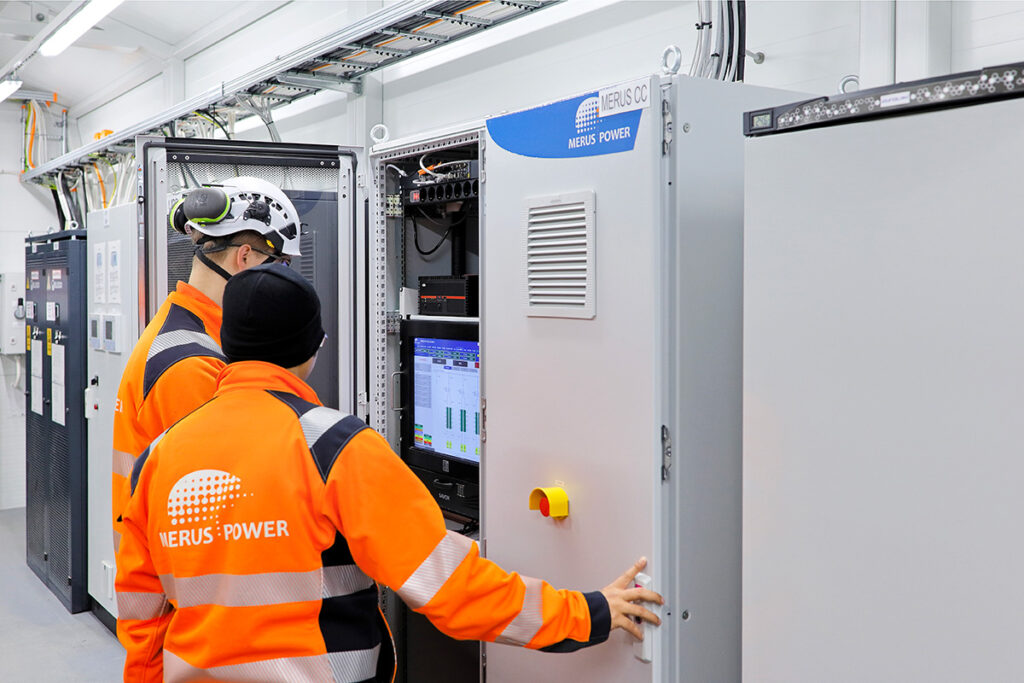
At Merus Power, we have been at the forefront of grid-forming BESS development in the Nordics. In 2025, we commissioned the Nordic region’s first grid-forming battery energy storage system together with Alpiq in Valkeakoski, Finland, successfully meeting Fingrid’s (Finland’s transmission system operator, TSO) demanding grid-forming requirements through extensive simulations and field testing.
4. Market participation testing (reserve market tests)
For many projects, the ultimate value of a BESS lies in participation in reserve and ancillary service markets. Commissioning therefore, includes:
- Frequency Containment Reserve (FCR) testing
- Automatic Frequency Restoration Reserve (aFRR) validation
- Response time and accuracy verification.
These tests verify response speed, accuracy, and operational reliability under real market conditions. In practice, they confirm that the system can deliver the fast and precise responses required to meet contractual obligations and generate expected revenue streams.
Without successful reserve-market testing, the project’s commercial viability remains unproven.
Why every test matters
One of the most important aspects of commissioning is that many tests are performed only once throughout the system’s lifecycle.
Some tests are not repeated annually, and some may never be repeated again after commissioning. Future operation, maintenance planning, warranty validation, and revenue generation all depend on the results established during this phase.
This makes commissioning a high-stakes opportunity to verify four essential areas:
- Safety
- Performance
- Compliance
- Revenue capability
Skipping rigor at this stage creates risks that can persist for years. Thorough commissioning reduces operational uncertainty, improves long-term reliability, and provides confidence that the system will perform as expected under real operating conditions.
The role of Merus Power
At Merus Power, commissioning is not treated as a final checkbox in project delivery. It is a critical stage where system performance, safety, grid compliance, and long-term operational readiness are validated in practice.
Our role extends far beyond equipment delivery. We support customers throughout the entire lifecycle of a BESS project, from system design and grid studies to installation supervision, commissioning, maintenance, remote monitoring, and long-term operational support.
Because our power electronics, EMS, PPC, and control software are developed in-house, we can ensure seamless integration between subsystems and faster resolution of commissioning challenges. This is particularly important in demanding applications such as reserve market participation, grid-forming operation, and weak-grid environments.
Our personnel have extensive experience in grid code compliance, system verification, reserve market integration, and utility-scale commissioning projects across the Nordics and international markets. Our commissioning teams work closely with customers, utilities, TSOs, and local authorities to ensure each project transitions smoothly into commercial operation.
In practice, successful commissioning is about much more than turning a system on. It is about ensuring that the BESS performs reliably under real grid conditions, supports the evolving energy system, and delivers measurable long-term value for the customer.
Get to know our solution!
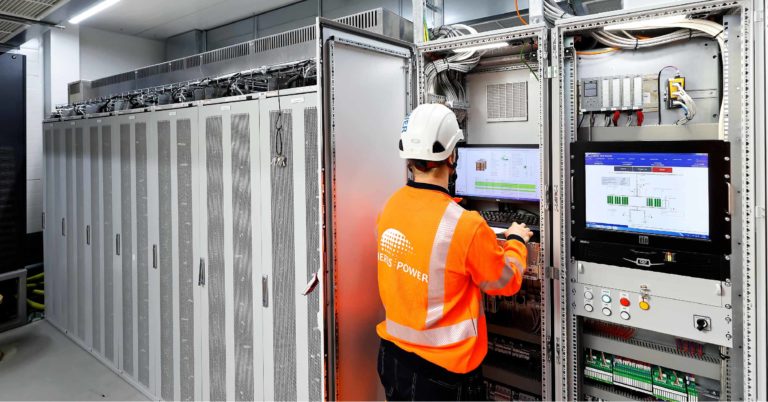
Merus® ESS – Energy Storage System
Merus® Energy Storage System is a scalable lithium-ion battery energy storage system fully designed by Merus Power.

Merus® PCS – Power Conversion System
Our Power Conversion System is an integral part of our battery energy storage system, designed and built in-house for scalability, efficiency, and reliable performance in all conditions.
Anything on your mind? Let’s talk!


Esa Lipsanen
Senior Sales Manager,
Energy Storage, Nordics