
Juhani Jaatinen
Senior Sales Manager,
DACH, Benelux, France, APAC

Frozen storage facilities depend on stable and reliable electrical power to keep refrigeration processes running continuously and safely. In modern facilities, Variable Frequency Drives (VFDs) are widely used to control motors efficiently, but they can also introduce harmonic distortion into the electrical network. In Japan, harmonic mitigation is guided by national requirements and calculation-based evaluations, making compliance an important part of ensuring reliable operation and grid compatibility.
At this frozen storage facility in Osaka, Japan, harmonic countermeasures were deemed necessary based on calculations performed in accordance with Japanese harmonic mitigation guidelines. Prior to installation, the system contained significant 5th– and 7th-order harmonic components, and the total harmonic distortion of current was observed at approximately 44% (around 63 A). This level of distortion created a clear need to reduce harmonics and bring power quality to an acceptable level for reliable long-term operation.
The solution implemented was a Merus® A2-150 Active Harmonic Filter. The system operates on a 200 V, 60 Hz power supply and supports a total of four variable speed drive units, consisting of two 140 A units and two 110 A units. All VSDs are equipped with built-in DC reactors.
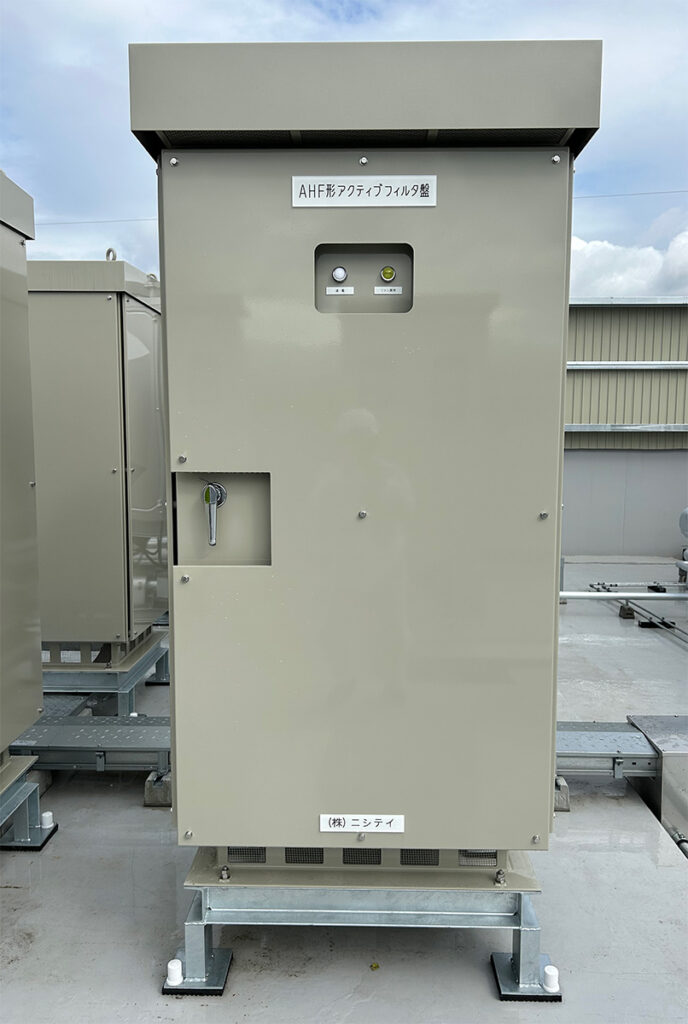
The filter was delivered in an outdoor enclosed control panel designed for demanding environments, including IP54 protection and an anti-salt corrosion coating. As part of the project documentation, seismic strength calculations for the panel foundation anchor bolts were prepared and submitted.
After installation, the 5th, 7th, and higher-order harmonics were effectively attenuated, and the current waveform was confirmed to be significantly closer to a sinusoidal shape. The improvement was also verified through harmonic spectrum analysis. As a result, the THDi was reduced to below 7% and remained stable at this level.
During tuning, it was confirmed that with a load current of approximately 128 A, harmonic distortion of about 44% corresponded to roughly 63 A of harmonic current, representing an active filter loading ratio of approximately 40%. Although the harmonic level was higher than initially expected during selection, the configuration was confirmed to provide comparable harmonic current removal as long as the load current remains at or below approximately 320 A. The customer was also advised that if load current increases in the future, an upgrade of active filter capacity should be considered.
| Metric | Before | After |
|---|---|---|
| THDi | ~44% | <5% |
| Harmonic levels | Significant 5th and 7th harmonics present | Effectively mitigated |
| Compliance position | Harmonic countermeasures required | Acceptable power quality achieved |
| Operational reliability | Increased risk | Improved reliability |
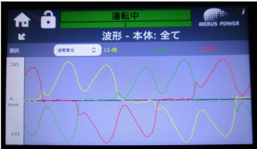
THDi levels before installing
the Merus® solution.
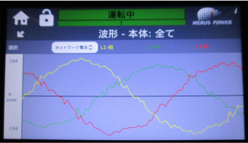
THDi levels after installing
the Merus® solution.
Frozen storage facility, Variable Frequency Drives
Osaka, Japan
Senior Sales Manager,
DACH, Benelux, France, APAC
Japan

2-1-1, Kobai, Yahata-nishi-ku
Kitakyusyu City, 806-0011
Japan
Contact person