
Juhani Jaatinen
Senior Sales Manager,
DACH, Benelux, France, APAC

Hospitals are mission-critical institutions that require a consistent, high-quality power supply. Modern healthcare environments use sophisticated and costly medical devices in settings ranging from intensive care units to surgical theatres. While these advanced equipment enhance care, they can also introduce power quality issues like harmonic distortion. Poor power quality can result in equipment malfunctions, a shortened lifetime of devices, patient data corruption or losses, and even safety hazards for patients and personnel. Operational reliability and availability cannot be guaranteed in the presence of harmonic distortions produced by non-linear loads.
When connected to the public grid, these facilities are susceptible to disruptions, including power outages and voltage sags. Such power quality challenges impact not only operational efficiency but also raise costs and compromise patient safety and comfort.
Our customer operates a private hospital, providing an extensive range of medical, surgical, and mental health services. Similar to many healthcare facilities, this hospital relies on Uninterruptible Power Supply (UPS) systems to ensure continuous power for critical medical devices. While UPS systems are essential for surgical instruments, ventilators, and monitors, they often contribute to power quality issues.
UPS systems can lead to harmonic current distortion. This distortion, stemming from the UPS systems’ non-linear nature, can adversely affect other medical equipment connected to the same electrical system by causing voltage waveform irregularities. Such issues may result in overheating of transformers and cables, reducing their lifespan and increasing the risk of equipment failure.
Additionally, sensitive electronic devices, like MRI and CT scanners, are particularly vulnerable to power disturbances. Power fluctuations can lead to data corruption and necessitate expensive repairs. More critically, unstable power can affect life support systems, posing a risk to patient safety. Ensuring stable and reliable power was thus crucial in our customer’s hospital, given the wide array of medical treatments it offers.
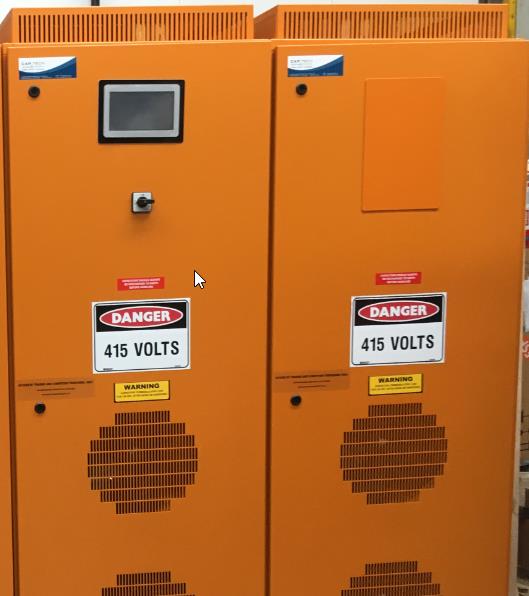
To effectively manage the power quality issues at the hospital, Merus Power’s trusted partner, Ampcontrol, installed the Merus® Hybrid Power Quality Compensator (HPQ). This innovative solution, combining a detuned capacitor bank with Merus® active harmonic filter modules, provides a blend of passive and dynamic reactive power compensation along with harmonic mitigation.
The Merus® HPQ stands out due to its intelligent control software, which continuously monitors system parameters for adaptive and flexible power quality control. This ensures the efficient and reliable operation of all hospital equipment, crucial for uninterrupted patient care. The system’s modular design and robust nature, coupled with local engineering support from Ampcontrol, were key in the decision-making process, especially considering the hospital’s need for space-efficient solutions that allow for future expansion. With the hospital housing a large amount of sensitive electronic equipment and striving to reduce electricity costs as part of a green initiative, the Merus® HPQ plays a vital role in maintaining acceptable levels of harmonic content and electricity demand.
After the installation and commissioning of the Merus® HPQ solution, a clear improvement in power quality was achieved. The versatile Merus® Solution efficiently managed the reactive power needs of the hospital’s electrical equipment while simultaneously filtering harmonics, safeguarding sensitive functions of the hospital from issues caused by poor power quality. In this type of healthcare environment, this enhancement ensures the reliable operation of vital medical equipment, providing increased safety for patients and personnel.
Hospital with various sensitive medical equipment, lighting and computers
Australia
Senior Sales Manager,
DACH, Benelux, France, APAC
Australia, Fiji, Papua New Guinea

1/100 New Street, Ringwood
VIC 3134, Australia
Contact person