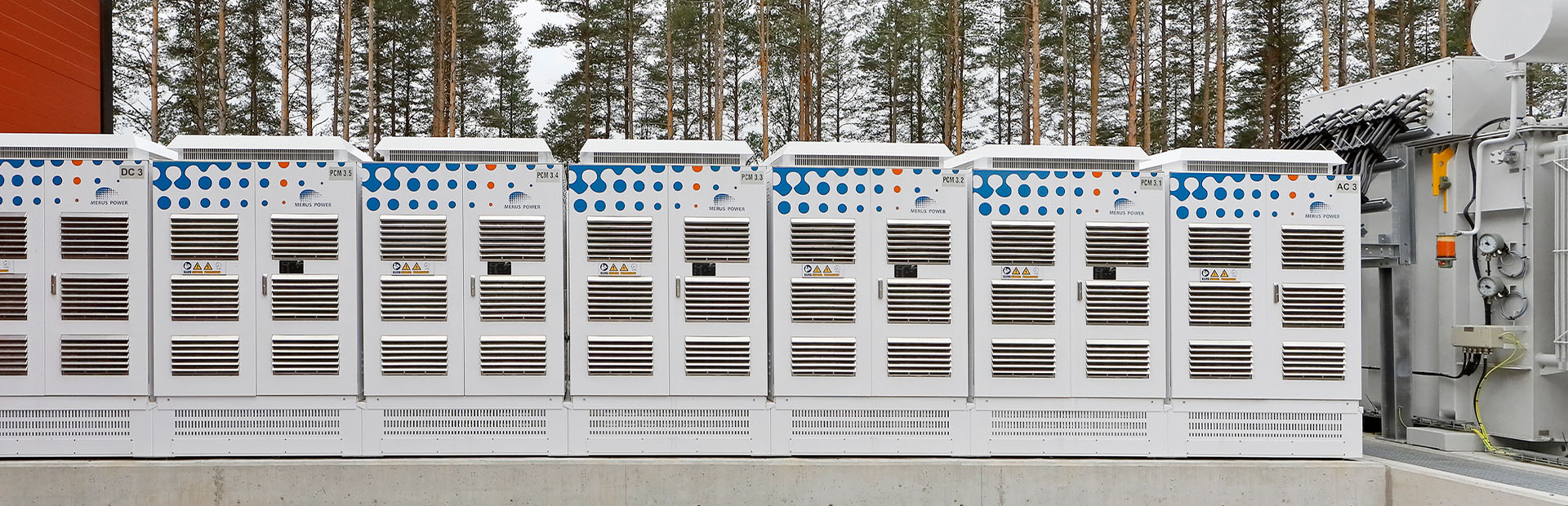
Grid-forming ability: from battery energy storage to grid asset
The power system is changing faster than ever.
Across Europe and globally, conventional synchronous power generation is being replaced by renewable generation, HVDC connections, and converter-based technologies. Wind and solar are scaling rapidly, battery energy storage systems (BESS) are becoming mainstream, and grids are becoming increasingly power-electronics driven. This transition is necessary, but it also changes the fundamental dynamics of the grid.
For decades, grid stability was supported naturally by large rotating machines. Today, many of those stabilizing sources are disappearing. At the same time, renewable generation is often geographically concentrated, creating weaker grid areas where voltage stability, oscillations, and fast-frequency dynamics become more challenging to manage. As the grid becomes more converter-dominated, converters themselves must become part of the stability solution.
This is where grid-forming technology enters the discussion.
Why grid-forming matters now
Traditional battery energy storage systems have mainly operated in grid-following (GFL) mode. A grid-following BESS behaves exactly as the name suggests. It follows an already existing voltage and frequency reference from the surrounding grid. This works well in strong networks where the grid itself remains stable and predictable.
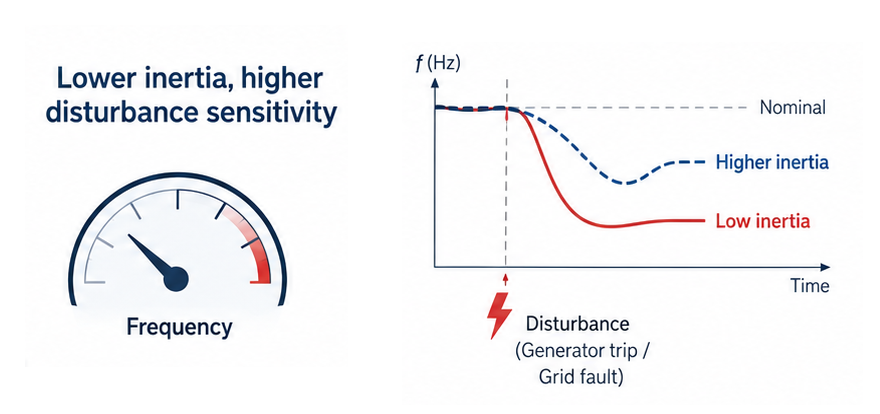
But weaker grids behave differently. In areas with high renewable penetration, low synchronous inertia, and large concentrations of converters, the grid reference itself can become unstable during disturbances. Frequency changes faster, voltage oscillations can emerge more easily, and control interactions between converters become more critical. Under these conditions, simply following the grid may no longer be enough.
Grid-forming (GFM) battery energy storage systems are designed differently. Instead of only following the grid, they actively contribute to stabilizing it.
One of the simplest ways to visualize the difference is through a running analogy.
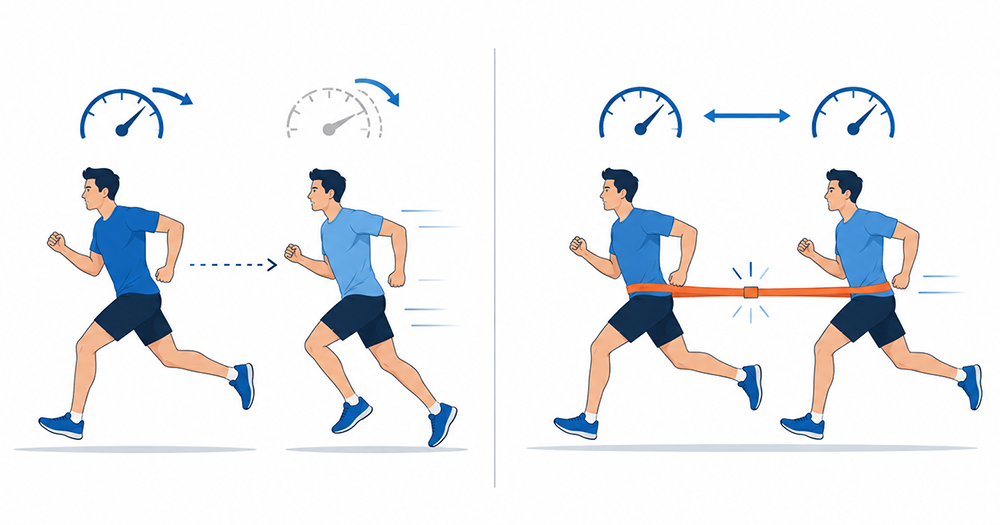
A grid-following system is like a runner trying to match another runner’s pace by watching and reacting. If the lead runner suddenly changes speed, there is always a delay before the second runner notices and adjusts. That delay can lead to overcorrection and instability.
A grid-forming system behaves differently. It is like two runners connected by a rubber band. If one runner suddenly accelerates or slows down, the rubber band immediately pulls them back together. The further or faster they separate, the stronger the stabilizing force becomes.
That is essentially what grid-forming technology brings to the power system: immediate stabilizing behavior rather than a delayed corrective reaction.
As power systems become increasingly converter-dominated, this difference becomes critically important.
Same market role, different dynamic behavior
An important point is that grid-forming does not change the commercial role of a battery energy storage system. In normal operation, a grid-following and a grid-forming BESS can look almost identical from the market perspective. Both can participate in reserve markets, follow dispatch schedules, and provide balancing services. Additionally, some markets have introduced compensation mechanisms for grid-forming capabilities, recognizing the contribution to system stability and resilience.
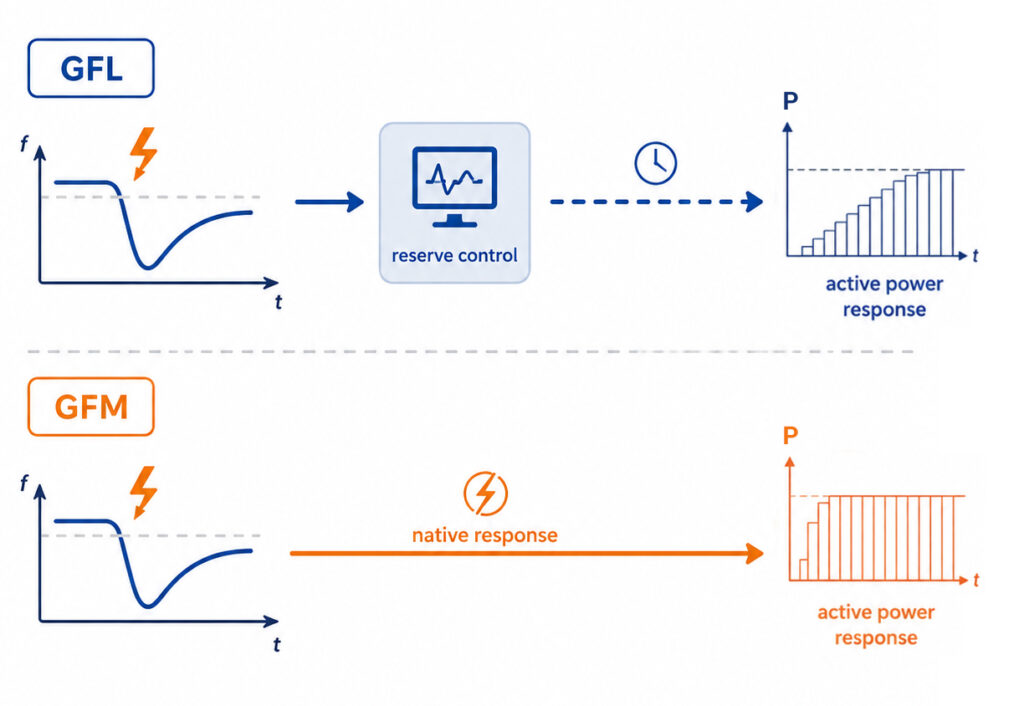
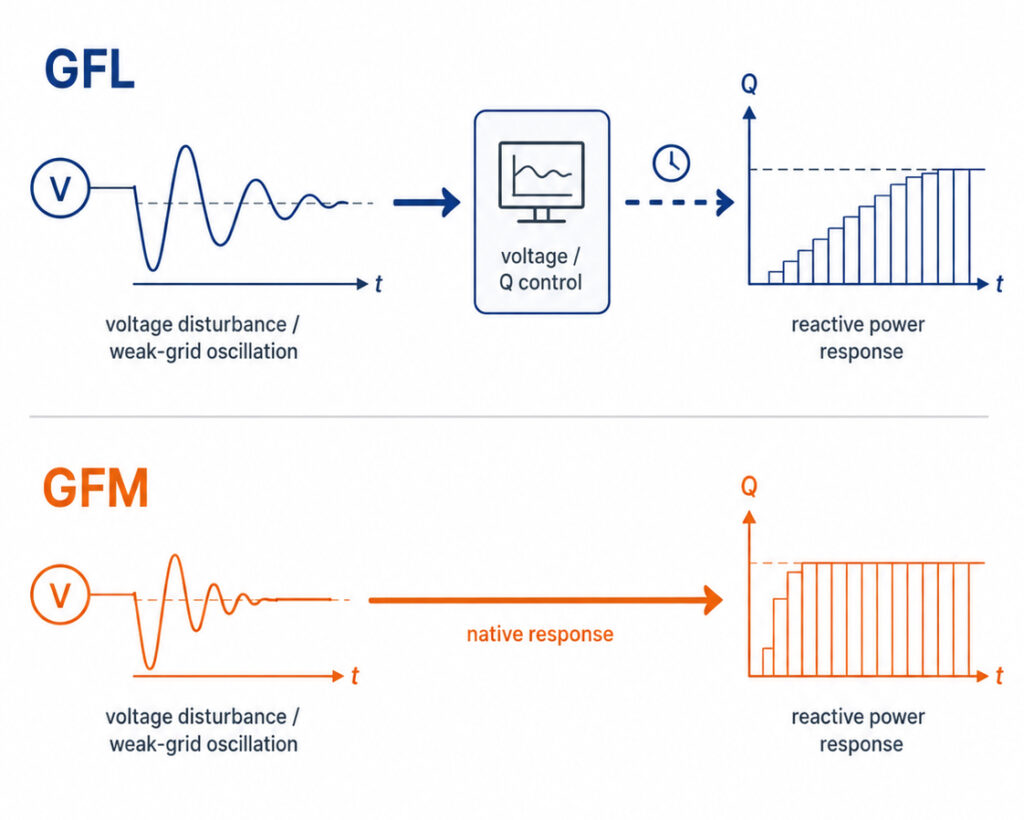
The difference appears during fast grid events. A grid-following system typically responds through measured signals and control loops. Frequency response is usually delivered through reserve controls such as FCR or FFR.
A grid-forming system responds natively to fast frequency and voltage dynamics. It reacts immediately to movement in the system itself, not only to measured deviations after they occur.
The same principle also applies to voltage support. Reactive power support is not a new technology. Battery systems have provided voltage control for years. What changes with grid-forming is the speed and behavior of the response.
Grid-forming systems behave more like controlled voltage sources. Their response is faster, more tightly connected to the disturbance itself, and often more stabilizing in weak-grid environments where oscillations can develop rapidly.
Weak grids are becoming a real operational challenge
These are no longer only theoretical discussions. Real grid stability challenges are already visible in several markets.
In Finland, for example, the west coast has seen a significant concentration of wind power within the same grid area. Finland’s Transmission System Operator (TSO) Fingrid has publicly discussed oscillation risks and converter-control interaction challenges in the region.
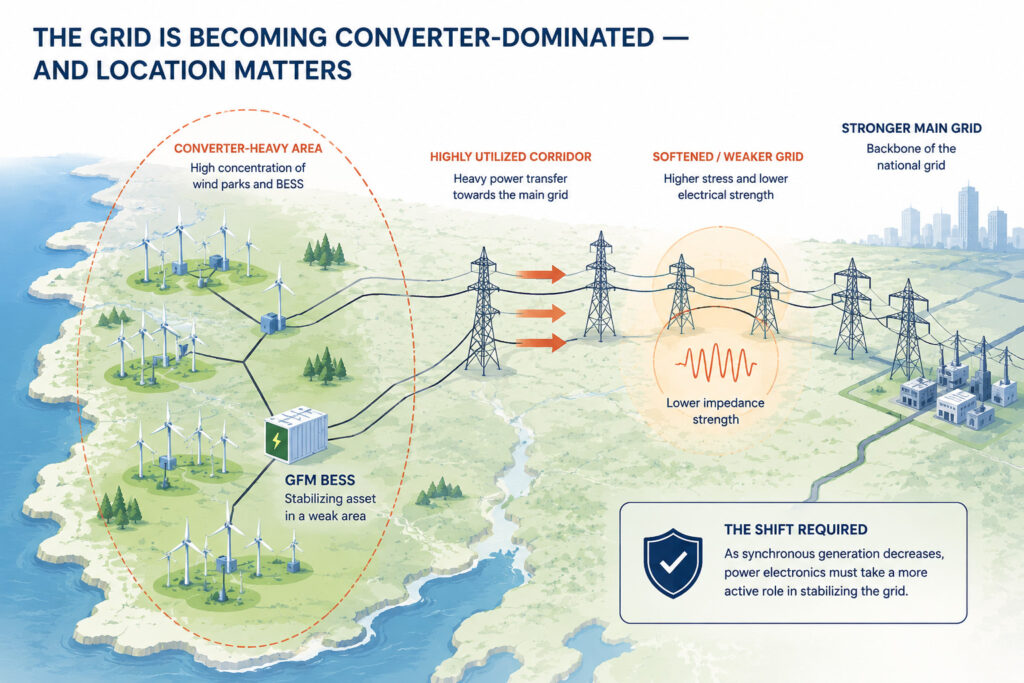
This is not only about energy balance anymore. It is about fast dynamic behavior inside increasingly converter-dominated networks. As converter concentration increases, delayed or poorly damped responses can amplify instability rather than reduce it. Large disturbances may expose limitations in voltage and reactive power control strategies. Grid-forming technology helps by adding fast voltage-source behavior and damping support directly into the system. This is also why many Transmission System Operators are moving toward grid-forming requirements.
Grid-code and market models are evolving globally
The interesting part is that countries are approaching the topic differently, but the direction is remarkably consistent.
Finland has taken one of the most proactive approaches through SJV2024, Fingrid’s Grid Code Specifications for Grid Energy Storage Systems. While grid codes have traditionally focused on ensuring that assets do not disturb the network, SJV2024 reflects a new reality: battery systems are increasingly expected to actively support system stability. The introduction of grid-forming requirements signals a broader shift in how Transmission System Operators view the role of energy storage in the future power system
Germany is enabling monetization through instantaneous reserve procurement models.
Great Britain has introduced grid-forming specifications alongside stability service procurement.
Australia has acted as an early mover through voluntary inverter specifications, while ERCOT in Texas has introduced advanced dynamic performance requirements that effectively demand grid-forming-like behavior. At the European level, ENTSO-E is also progressing toward broader grid-forming frameworks under the evolving RfG 2.0 discussions.
The common denominator is clear. Battery systems are increasingly expected not only to deliver energy and reserves, but also to actively support grid stability.
Why Merus Power focuses on real operational grid-forming capability
One misconception in the market is that grid-forming is simply a software feature that can be added on top of any battery system. In reality, achieving reliable grid-forming performance requires deep integration across the full power conversion chain. Power electronics, controls, grid-connection software, simulation models, protection schemes, and system integration all play a role. It also requires validated Electromagnetic Transients (EMT) models, field testing, and close interaction with transmission system operators. As grid-code requirements become stricter, dynamic performance validation becomes part of overall project quality, not only a technical add-on.
At Merus Power, grid-forming capability has already moved beyond development work into real operating projects. Multiple Merus Power’s BESS plants are already operating in grid-forming mode in Finland, including projects in Valkeakoski, Lappeenranta, and Riihimäki.
The Valkeakoski project for Alpiq was publicly announced as the first grid-forming BESS in the Nordics participating in reserve markets.
These projects have provided valuable practical experience not only in simulations and testing, but also in commissioning and real operational environments. This operational experience matters.
As grid-forming requirements continue evolving, practical implementation quality will increasingly separate proven solutions from theoretical capability claims.
What does this mean for future BESS projects?
Battery energy storage systems are evolving from energy assets into active grid assets. This changes how projects must be designed. Power Conversion System (PCS) selection is no longer only about efficiency or price. Dynamic performance, control capability, and grid-code compliance are becoming strategic project criteria.
System integration quality, EMT validation, and field-proven control performance are becoming increasingly important parts of project execution. Ultimately, future battery projects will likely be evaluated not only by how much power they can deliver, but also by how effectively they support the grid while delivering it.
Conclusion: the role of BESS is changing permanently
The energy transition is no longer only about adding renewable generation capacity. It is also about maintaining grid stability in a fundamentally different type of power system. In the future, BESS projects will not be evaluated only by energy capacity, efficiency, or reserve market revenues. They will increasingly be evaluated by how effectively they support system stability during fast dynamic events.
Grid-forming capability is becoming part of the foundation of modern grid infrastructure. For developers, utilities, and investors, this means that technology choices made today will have long-term implications for grid code compliance, operational reliability, and future market participation.
For technology providers, it means delivering more than battery containers and inverters. It means delivering validated dynamic performance, system-level understanding, and real operational experience.
At Merus Power, we believe the industry is only at the beginning of this transition. The grid of the future will require converter-based assets not only to connect to the network, but to actively strengthen it.
Anything on your mind? Let’s talk!

Teemu Paakkunainen
Product Manager,
Battery Energy Storage Systems